
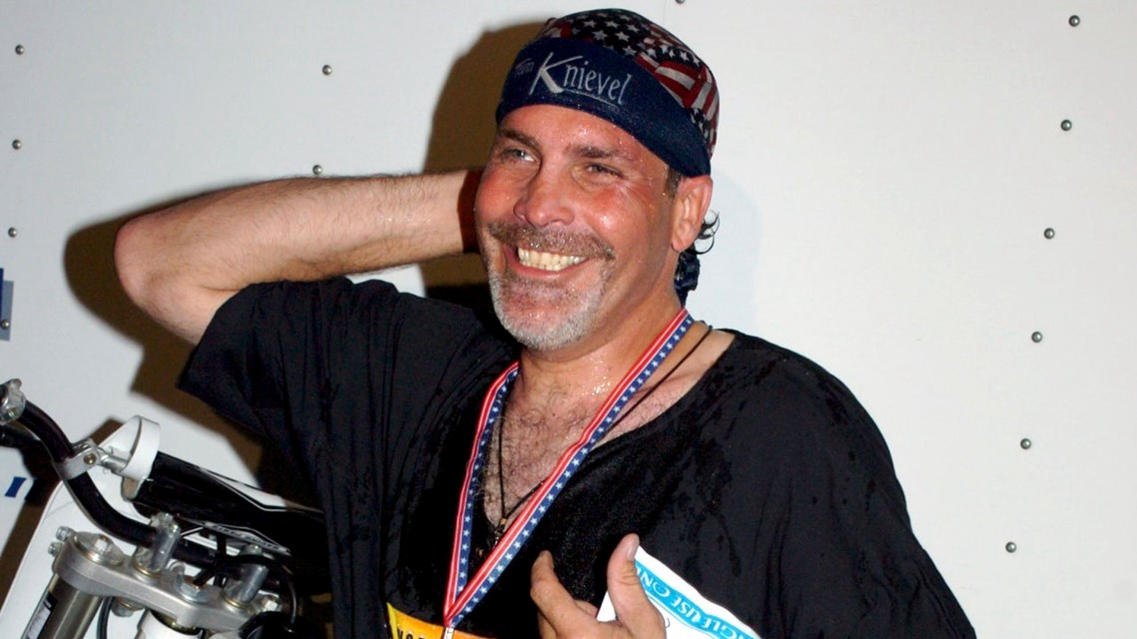
At the time of his death in January 2023, Robbie Knievel had an estimated net worth of $2 million.
A celebrated American motorcycle stunt performer, Robbie carved out his own legacy while carrying the iconic Knievel name.
As the son of legendary daredevil Evel Knievel, he embraced the high-risk world of televised motorcycle jumps and became a prominent stunt figure in his own right.
Over the course of his career, Robbie completed more than 350 jumps, many broadcast live to national audiences.
Among his most famous feats were his successful Caesars Palace jump in 1989 a stunt that redeemed his father’s infamous 1967 crash and his ambitious Grand Canyon jump attempt in 1999.
Though his career was defined by risk and injury, Robbie solidified his place in the pantheon of American daredevils.
Early Life And Education
Robbie Knievel was born Robert Edward Knievel II on May 7, 1962, in Butte, Montana. He was the second of four children born to Evel Knievel and his first wife, Linda Bork. Growing up in a household synonymous with spectacle and risk, Robbie was introduced to stunt riding at an exceptionally young age.
By just four years old, he was already jumping on bicycles, and by seven, he had graduated to motorcycles.
At eight, he made his debut performance alongside his father at Madison Square Garden, marking the beginning of a life lived in the spotlight.
As he grew older, Robbie toured with Evel, performing pre-jump exhibitions and absorbing the intricacies of stunt entertainment.
He attended Central Catholic High School as a teenager but did not complete his formal education, opting instead to focus fully on his developing stunt career.
Motorcycle Jumping Career
While inevitably compared to his father, Robbie Knievel distinguished himself through both equipment choice and performance style.
Unlike Evel, who favored the heavier Harley-Davidson XR-750, Robbie rode Honda CR500 motocross bikes, which were roughly 90 pounds lighter. The difference allowed for increased maneuverability and different jump dynamics.
Visually, however, he maintained the Knievel tradition—wearing red, white, and blue jumpsuits reminiscent of his father’s iconic patriotic attire.
One of the most defining moments of Robbie’s career came in 1989, when he completed the Caesars Palace fountain jump in Las Vegas, 22 years after his father’s failed attempt left him severely injured.
The event marked Robbie’s first live televised jump and symbolized a generational redemption.
In 1993, he faced British stuntman Eddie Kidd in a televised jump-off competition in Mississippi. Although Kidd won on cumulative distance, Robbie set a new American Motorcycle Association record with a 223-foot jump.
He surpassed that distance in 1996 by clearing ten limousines on the Las Vegas Strip with a 230-foot leap.
In 1999, Robbie undertook two major televised jumps. In February, he successfully cleared a 130-foot gap between the Jockey Club towers in Las Vegas.
Later that year, he attempted one of his most daring feats: a 220-foot jump over a Grand Canyon-area chasm. The attempt ended in a crash that resulted in a broken leg.
Throughout the 2000s, Robbie continued staging high-profile jumps, including clearing a moving locomotive in Texas, military aircraft aboard the USS Intrepid in New York City, and dozens of trucks and military vehicles at various venues nationwide.
In 2007, he was inducted into the Motorcycle Hall of Fame in recognition of his contributions to the sport.
His final televised jump took place on New Year’s Eve 2008 in Las Vegas, and his last professional jump occurred in October 2011 in Coachella, California.
Other Appearances
Beyond stunt performances, Robbie Knievel made appearances in popular television shows such as “CHiPs” and “Hawaii Five-0.”
In 2005, he starred in his own A&E reality series, “Knievel’s Wild Ride,” offering viewers behind-the-scenes insight into the pressures and preparations surrounding his jumps.
In 2017, his life and career were chronicled in the documentary “Chasing Evel: The Robbie Knievel Story,” which explored both his achievements and the challenges of living in the shadow of a legendary father.
Business Ventures
In addition to his stunt career, Robbie ventured into entrepreneurship. In 2006, he launched a custom motorcycle business in Lake Hopatcong, New Jersey.
The venture reflected his lifelong passion for bikes and mechanical craftsmanship, further extending the Knievel brand beyond televised stunts.
Personal Life And Death
Robbie Knievel was the father of three daughters—Krysten, Karmen, and Maria—and a grandfather to two grandchildren, Analise and Kane.
On January 13, 2023, Robbie passed away at a hospice facility in Reno, Nevada, following a battle with pancreatic cancer. He was 60 years old.
His death marked the end of a daring chapter in American stunt history, but his legacy as a fearless performer endures.
FAQ
How many jumps did Robbie Knievel complete?
Throughout his career, Robbie completed more than 350 motorcycle jumps, many of which were televised live.
Did Robbie Knievel complete the Caesars Palace jump?
Yes. In 1989, he completed the Caesars Palace fountain jump, succeeding where his father had famously crashed in 1967.
What happened during Robbie Knievel’s Grand Canyon jump?
In 1999, Robbie attempted to clear a 220-foot chasm near the Grand Canyon. He crashed during the stunt and suffered a broken leg.
When did Robbie Knievel retire?
His final televised jump occurred in 2008, and his last professional jump took place in October 2011.